
A for Authorship
In ETEC 540, The Changing Spaces of Reading and Writing, I and my colleagues have discussed “the shift from orality to literacy among certain cultures, and with early technologies for writing” (Prefatory Material, ETEC 540). I have examined technologies for writing before the invention of the computer and, later on, with computer-based technologies. I also looked at multimodal forms of literacy, such as hypertext and hypermedia, as well as other forms of writing like wikis, weblogs and other social media tools.
In this course, we used a community weblog, an online hypertextual environment that community members have developed collaboratively. You can view the community weblog by clicking on its link.
ETEC 540 was eye-opening in terms of the challenges hypermedia might present for the future of literature, literacy and teaching. Moreover, I looked at how social media and Web 2.0 technologies are challenging the practices of hypertext and hypermedia.
I called this section A for Authorship because of the act of writing it entails. The networked possibilities the 21st century has created and those multiple spaces for writing have dramatically changed the way we view the term “authorship.”
Chosen Artifacts
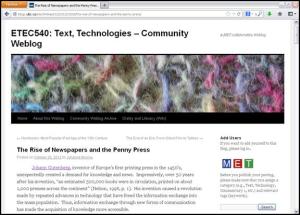
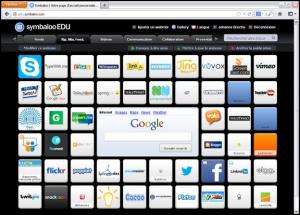
The two artifacts I chose to discuss are, first, a research project called The Rise of Newspapers and the Penny Press, which I posted in the Community Weblog, and, second, a collection of Web 2.0 tools in educational technology that I chose for posting in EDUsymbaloo.com. In order to get to the artifacts, you can click on the titles’ corresponding links or on the pictures below.
Artifact #1: The Rise of Newspapers and the Penny Press
Artifact #2: Rip. Mix. Feed. Reloaded: A mix of Web 2.0 Tools in Educational Technologies
Context
It was a course requirement that we post our work in the community weblog in which all members were collaborating; writing in an online hypertextual environment was a new experience for me.
Reason
I find the two artifacts to be good demonstrations of online environments that can easily be utilized in teaching, for sharing information and for collaboration among students. These artifacts are meaningful to me because they are the exact types of artifacts I had already started to use in my online courses to enrich students’ experiences in networked writing environments. It is interesting to experiment with these environments to see how they encourage what Ong (2002) has called “secondary orality.”
Discussion
The changing spaces of communication are encouraging multiliteracy because of the multiplicity of cultures and linguistic groups in the social spaces. What the New London Group (1996) called “a pedagogy of multiliteracies” is a means of “creating access to the evolving language of work, power, and community, and fostering the critical engagement necessary for them to design their social futures and achieve success through fulfilling employment” (p. 60). These spaces are changing so fast because of “local diversity and global connectedness” (The New London Group, p. 196, p. 64) and it is changing the face of literacy; that is why the authors from this group use the term “multiliteracies”.
These changes started centuries ago when Johann Gutenberg, the inventor of the printing press in 1450, “created a demand for knowledge and news” (Brochu, 2012). His invention sparked the mass distribution of information, which has advanced even further because of advances in technology. Indeed, in the 21st century, new technologies are making information exchanges and acquisition of knowledge accessible to all who are willing to connect through social and other forms of media. The multiple forms of communication have built communities but also, according to the New London Group (1996), are changing “our working lives, our public lives (citizenship), and our private lives (lifeworld)” (p. 65).
Hence, media of mass communication using new technologies, for example Facebook and Twitter, create what Ong (2002) called “the literate minds” where decisions are “shared among writers and readers” (Bolter, 2001, p. 16) (Brochu, 2012). The fact that individuals are using different modes of representation to express themselves makes dynamic the spaces in which communication is happening.
Reflection
We are able to access a variety of spaces to communicate using different modes of representation. These modes vary; they can be written, visual, and/or oral. In addition, the easy access to open sources and eTools makes the Web an accessible space which can almost be seen as a large community of practice (CofP).
Interestingly, a couple of weeks into the ETEC 540 course, I realized that I would have to write in new spaces I was not used to, for example in a community weblog and in a wiki site. At first, it was intimidating and I felt uncomfortable participating in discussions outside of Vista. The fact that these spaces are open to the world to see might be appealing for some and I believe that there is a great deal that can be learned from it. What I have learned also is that there are different modes of expression that can be used. Perhaps that is one of the reasons why visual modes of representation were encouraged while publishing the texts we wrote in the community weblog; a picture can be worth a thousand words.
In addition, for the last assignment I prepared a collection of Web 2.0 tools in educational technologies using EDUsymbaloo.com; these are some of the tools I am using or plan on using in my teaching environment. In my desire to put theory to practice, I am preparing a weblog in WordPress which is going to be a space where my students can collaborate on projects, share their thoughts and discuss with each other: it is called Les productions en FRA4U. If you wish, you can view it by clicking on the title. I plan on having this weblog private as I am concerned about the privacy of my students. This weblog, I believe, is going to be a good learning practice; students tend to work harder when they know that peers are accessing their work. As per the EDUsymbaloo organizing eTool, I plan to prepare a Symbaloo page with links to particular tools my students would like to work with; the site is user-friendly and offers a lot of possibilities for viewers interested in new technology. However, as Postman (1992) stated, “our task is to understand what that design is — that is to say, when we admit a new technology to the culture, we must do so with our eyes wide open” (p. 7).
My special thanks to Dr. Teresa Dobson, who provided me with thoughtful feedback on my different assignments (Fall, 2012).
References
Bolter, J. D. (2001). Writing space: Computers, hypertext, and the remediation of print [2nd edition]. Mahwah, NJ: Lawrence Erlbaum.
Brochu, J. (2012). The Rise of Newspapers and the Penny Press (unpublished graduate essay). University of British Columbia, Vancouver, Canada.
Ong, W. J. (2002). Orality and literacy: the technologizing of the word. London: Routledge.
Postman, N. (1992). Technopoly: The surrender of culture to technology. New York: Vintage Books.
The New London Group. (1996). A pedagogy of multiliteracies: Designing Social Futres. Harvard Educational Review, 66(1), 60-92. Retrieved from http://www.pwrfaculty.net/summer-seminar/files/2011/12/new-london-multiliteracies.pdf
 Johanne Brochu's MET ePortfolio