
P for Pedagogy
The origin of the word comes from France in the late 16th century (1580s), “from Middle French pédagogie” (Online Etymology Dictionary). It refers to “the method and practice of teaching, especially as an academic subject or theoretical concept” (Online Oxford Dictionaries). In Greek antiquity, the French term “pédagogue” refers to a person who educates children in a family. To the Romans it is related to a slave or a person who occupied the same role. So, the significance of the term has changed frequently depending on pasts and people. Generally, it refers to the masters who educate or most specifically to the teachers in respective disciplines of teaching that are related to pedagogy (Office québécoise de la langue française).
In ETEC 532, Technology in the Arts and Humanities Classroom, I was invited “to explore the possibilities and challenges of integrating technology into the art and humanities classroom” (General Welcome, course material). Collaborative learning was an important part of the course where we worked in groups of two, four and five during the semester. In this particular course, editing others’ work was done on a continual basis. This particular way of working/interacting with peers colleagues was worthwhile; I did learn a lot from the experience.
As in all MET courses, participation was also assessed by quality and quantity of contributions. Clearly, this is an interesting way of verifying students’ progress through the course material as they show “critical thinking skills, personal reflection, and application to practice” (Course Syllabus, ETEC 532).
After having experienced it in all MET courses, I can say that learning together in a community of practice (CofP), which is the hallmark of social constructivism (Vygotsky), really improves knowledge building. As students are facing others’ thoughts, it allows them to reflect on their own learning and how they process it. Indeed, they may consider what changes can be done in order to better progress through the course material.
To ensure the development of a healthy learning community in an online program like the MET, teachers must take the role of facilitators. Palloff and Pratt (2005) stated that, “Collaboration does not just happen. It takes planning and coordination on the part of the instructor to carry out collaborative activity successfully in an online class” (p. 19). Students are taking charge of their learning and teachers are becoming the experts who facilitate what and how they learn. Groups working on specific questions/topics or projects/presentations while in an online course need some engagement and effort from everyone, and, in the end, it is important that everyone is assessed individually by the group’s members. I believe that it gives value to the collaboration.
Through the MET program, in some of the courses, ETEC 510, ETEC 511, ETEC 512, ETEC 565, and ETEC 520, I had the opportunity to collaborate in group projects.
You can find these projects by clicking on the links below.
ETEC 510: Teaching and learning a foreign language: An online non-credit course for adults (Group Design Project Proposal and Final Paper) and Culture and Language Panorama (Creative Moodle Website – see section T for Technology).
ETEC 511: The Psychology & Phenomenology of Educational Tech (Group Presentation Project).

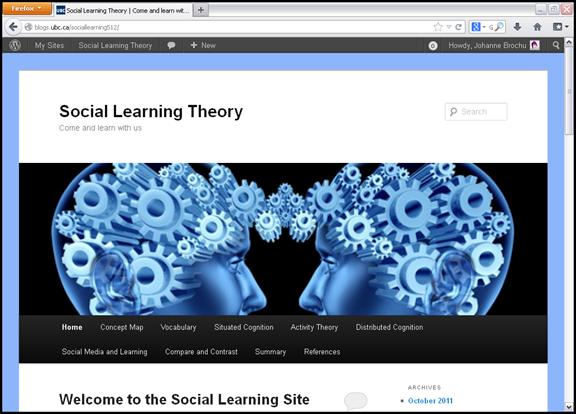
ETEC 512: Social Learning Theory (Group Presentation Project).
ETEC 520: Recommendations for a Borderless University of British Columbia (Group Report Project).
ETEC 565: Delivery Platform Evaluation Rubric (Group Rubric Assignment Project).
Chosen Artifacts
The artifacts I choose to discuss in this part of my ePortfolio (eP) are related to the integration of students’ ePortfolios (ePs) in high school online courses. The first paper is a review of literature on the topic. The final paper focused on how digital technology integration is happening in online learning and how the barriers to their incorporation should be addressed to enhance student learning.
Artifact #1: Annotated Bibliography and Literature Review – The Integration of E-Portfolios in the Classroom: Is Students’ Learning Being Enhanced?
Artifact #2: Final Project – The Integration of E-Portfolios in High School Online Courses
Context
In this project, which includes a literature review and a final paper, I was encouraged to critically examine the use of technology in the arts and humanities classroom while focusing on my teaching context. During the same time, the Ontario Ministry of Education (OME) strongly suggested that teachers promote the use of ePs by K-12 students. This fact alone inspired me to pursue my research in the area.
Reason
Consequently, I chose this topic because at the time, in the summer of 2012, I was looking at integrating ePs in my online courses. I looked at the pros and cons of high school students building their ePs; the purpose and organization of the ePs were my main concern. In addition, I was hoping to find in the literature some of the best practices for their integration.
Discussion
In ETEC 532 I had the opportunity “to explore the connections between pedagogy, curriculum and technology in multiple settings” (Course Syllabus, ETEC 532). As Palloff and Pratt (2009) mentioned, it is important to ensure that students are engaged with the course content as much as possible and a way of doing it is to develop the spaces where they can find the support they need to achieve their goals. EPs are usually used to help students reflect on their learning growth. In that regard, the planning of the eP design is key; the more each individual can tailor them to their needs, the more sense they will make and the more efficient they will be.
Furthermore, the guidance of an expert, an educator, is also an important element of their success; it might just empower students to reflect on and explore further their individual potential. The integration of ePs in the classroom may involve training for the educators (Blair & Godsall, 2006; Buzzetto-More & Alade, 2008). Indeed, it is suggested in the literature I read that teachers’ enthusiasm for new technology will be reflected by their students — it will empower them.
In addition, the social interaction that is happening through peers’ and educators’ feedback in ePs development encourage the acquisition of knowledge, which corresponds to Lave and Wenger’s (1991) theory called situated learning. Once again, the development of a Community of Practice (CofP) where knowledge building can happen is what all the 21st century is all about.
Reflection
While choosing a new technology to be integrated into a course design, it is important to question how this technology will help students improve their learning. Will they have the proper academic and technical support needed for them to reach their goals? There is no doubt in my mind how important the experts are in helping students build their own ePs. Even the most creative students may eventually need this guidance. Building an eP needs time and reflection; it is a complex task that needs engagement and dedication from the students.
Therefore, using ePs as well as other type of new technology often provides authentic ways of learning where students have to demonstrate their abilities at using them while the technology assists them with personal and professional activities. That said, it requires good planning on the part of the teacher. Connections must be made within pedagogy and curriculum so students’ learning growths can be ensured. Moreover, “the distribution of technology implementation is very much a function of the distribution of social relations within the schools” (Zhao & Frank, 2008, p. 830).
Pedagogy is really important in the educational world; a good teacher must be a good pedagogue. I believe that the ability of being a good pedagogue may be natural for some people. But even the teacher with the best pedagogy may face challenges trying to change the way things have traditionally been done. Thus, the idea of having to change cultures around us means having to face others’ points of view, others’ way of doing things that do not always mesh with ours. Moreover, in this era of new technologies, educators and students have to make some shifts in order to accommodate new trends in education.
Thank you so much to Dr. Alex De Cosson, who has been such a great facilitator through this course (Summer 2012).
References
Blair R., & Godsall, L. (2006). One school’s experience in implementing e-portfolios. Lessons learned. Quaterly Review of Distance Education, 7(2), 145-153. Retrieved from http://web.ebscohost.com.ezproxy.library.ubc.ca/ehost/pdfviewer/pdfviewer?sid=8683cd8f -802f-4910-b4c4-0691423694f9%40sessionmgr11&vid=2&hid=19
Buzzetto-More, N., & Alade A. (2008). The pentagonal e-portfolio model for selecting, adopting, building, and implementing an e-portfolio. Journal of Information Technology Education, 7, 45-70. Retrieved from http://web.ebscohost.com.ezproxy.library.ubc.ca/ehost/pdfviewer/pdfviewer?sid=911338e6-9a15-4392-94d6-bfdd725b7fc1%40sessionmgr4&vid=2&hid=19
Lave, J., & Wenger, E. (1991). Situated Learning: Legitimate Peripheral Participation. Cambridge England, New York: Cambridge University Press.
Palloff, R. M., & Pratt, K. (1999). Building learning communities in cyberspace: Effective strategies for the online classroom. San Francisco: Jossey-Bass.
Palloff, R. M., & Pratt, K. (2001). Lessons from the cyberspace classroom: The realities of online teaching. 17ht Annual Conference on Distance Teaching and Learning, 1-5. Retrieved from http://www.uwex.edu/disted/conference/resource_library/proceedings/01_20.pdf
Palloff, R. M., & Pratt, K. (2005). Collaborating Online: Learning Together in Community. (pp.xi-109). San Francisco: Jossey-Bass.
Palloff, R. M. & Pratt, K. (2009). Assessing the online learning: resources and strategies for faculty. San Francisco: Jossey-Bates.
Pedagogy. (n.d.). Online Oxford Dictionaries. Retrieved from http://oxforddictionaries.com/definition/english/pedagogy?q=Pedagogy
Pédagogie and pédagogue. (n.d.). Online Etymology Dictionary. Retrieved from http://etymonline.com/index.php?allowed_in_frame=0&search=pedagogy&searchmode=none
Pédagogie. (n.d.). Office québécoise de la langue française. Retrieved from http://gdt.oqlf.gouv.qc.ca/ficheOqlf.aspx&Id_Fiche=8991243
Zhao, Y., & Frank, K. A. (2008). Factors affecting technology uses in schools: An ecological perspective. American Educational Research Journal, 40(4), 807-840. Retrieved from http://blogs.ubc.ca/etec511ecology/files/2011/11/zhaofrank2003.pdf
 Johanne Brochu's MET ePortfolio
I absolutely love your website.. Great colors & theme.
Did you build this amazing site yourself? Please reply back
as I’m attempting to create my own website and want to know where you got this from or what the theme
is named. Many thanks!
Hi! Yes, I did build this website myself. There are no particular skills needed to built a website like this one. All you need is think about what you want to do and just do it. Thank you for your nice comment! ;o)